
Succession Planning Basics for Indian Organisations
WORKFORCE PLANNING & MANPOWER
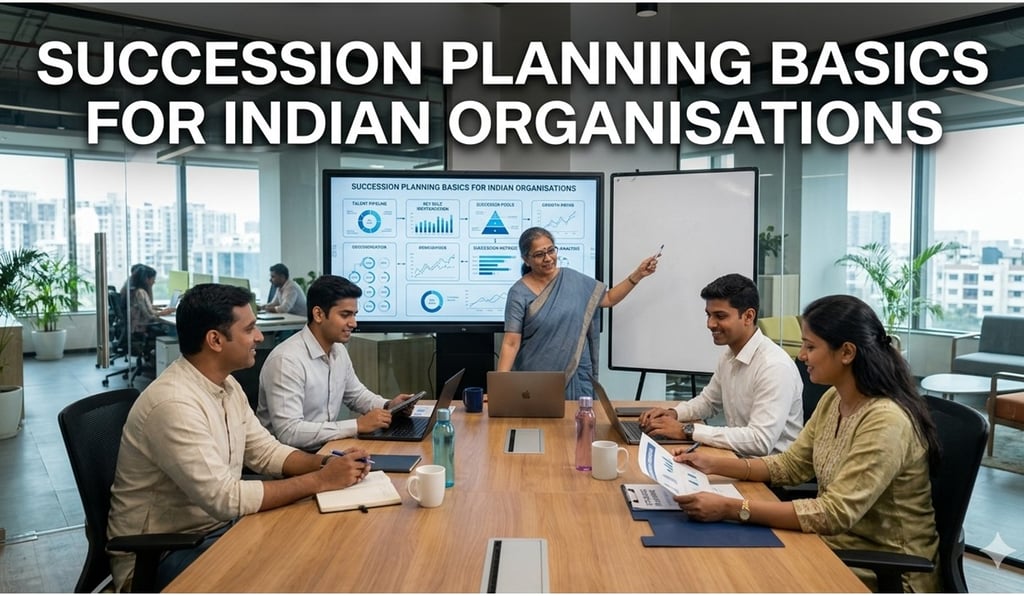
Succession planning is often misunderstood as a leadership-only exercise or something relevant only for large organisations. In reality, even mid-sized and growing Indian companies face continuity risks when critical roles are held by a single individual. This article explains succession planning in practical terms—what it really means, why it matters for Indian workplaces, and how HR can approach it without overengineering the process.
What Is Succession Planning (In Simple Terms)
Succession planning is the process of identifying critical roles and preparing internal talent to step into them when needed—due to resignation, retirement, promotion, or sudden absence.
It is not:
A replacement chart prepared only for audits
A confidential list limited to top leadership
A one-time annual exercise
Instead, it is a forward-looking workforce continuity practice that links people readiness with business stability.
Why Succession Planning Matters in Indian Organisations
Indian workplaces face unique realities:
High dependency on individuals rather than roles
Limited documentation of processes
Rapid growth without parallel talent development
Sudden exits due to better opportunities
Without succession planning, organisations face:
Operational disruptions
Delayed decision-making
Knowledge loss
Increased external hiring costs
A basic succession plan helps HR reduce risk, not promise promotions.
Identifying Critical Roles
Not every role needs a successor. HR should focus on roles that are:
Business-critical or revenue-impacting
Difficult to replace externally
Dependent on institutional knowledge
Central to compliance or stakeholder management
Examples:
Payroll or compliance lead
Plant HR / IR manager
Key client-facing managers
System or process owners
Identifying Potential Successors
Potential successors need not be “ready now.” They may be:
Ready now – can step in with minimal support
Ready soon – need development over 6–12 months
Future potential – need longer-term exposure
HR should assess:
Skill readiness
Behavioural maturity
Learning agility
Willingness to take responsibility
This assessment should remain development-focused, not promotional.
Development Actions for Succession Readiness
Succession planning works only when paired with development actions such as:
Job shadowing
Role rotation
Exposure to decision-making forums
Targeted training
Mentoring by current role holders
These actions can be low-cost and integrated into existing work, especially in SMEs.
Common Mistakes HR Should Avoid
Treating succession plans as confidential “lists”
Promising promotions implicitly
Focusing only on leadership roles
Ignoring operational and compliance roles
Creating complex frameworks that are never reviewed
Succession planning should be reviewed periodically, not stored and forgotten.
Simple Succession Planning Checklist for HR
Before starting:
Identify 5–10 truly critical roles
Clarify why each role is critical
While planning:
Identify at least one potential successor per role
Assess readiness honestly
Document key responsibilities and dependencies
After planning:
Define at least one development action per successor
Review progress annually or during manpower reviews
Update plans after major organisational changes
How Succession Planning Fits into Workforce Planning
Succession planning complements:
Manpower forecasting
Skills gap analysis
Internal mobility planning
Leadership development
Together, these practices help HR move from reactive hiring to proactive workforce readiness.
Succession Planning Checklist for HR
Use this checklist as a starting point to build a basic, workable succession plan without overcomplicating the process.
Step 1: Identify Critical Roles
☐ Does the role have a direct impact on business continuity or compliance?
☐ Is the role difficult to replace quickly from the market?
☐ Does the role involve significant institutional knowledge?
☐ Would the absence of this role disrupt operations or decision-making?
Step 2: Identify Potential Successors
☐ Have at least one potential successor been identified for each critical role?
☐ Is the assessment based on skills, behaviour, and learning ability—not tenure alone?
☐ Are readiness levels clearly identified (ready now / ready soon / future potential)?
☐ Have informal discussions been held with managers (without making promises)?
Step 3: Assess Development Needs
☐ Are key skill gaps clearly documented?
☐ Does the successor need exposure, mentoring, or training?
☐ Can development actions be integrated into current work?
☐ Are timelines realistic and aligned with business needs?
Step 4: Plan Development Actions
☐ Have practical actions been defined (job shadowing, role rotation, mentoring)?
☐ Is accountability assigned to managers and HR?
☐ Are actions tracked informally or documented simply?
☐ Is progress reviewed at least annually?
Step 5: Review and Update
☐ Is the succession plan revisited during manpower or workforce reviews?
☐ Are changes made after resignations, promotions, or restructures?
☐ Are outdated assumptions removed?
☐ Is the plan kept current and usable?
Practical Reminder for HR
Succession planning is a risk-management and development exercise, not a guarantee of promotion. Transparency, simplicity, and regular review matter more than perfect documentation.
Conclusion--
Effective labour law compliance depends on how well HR operations, payroll, and business processes work together. When compliance is embedded into everyday workflows, organisations reduce risk, improve accuracy, and build sustainable governance systems. HR teams that prioritise integration over isolation are better positioned to manage compliance confidently and consistently.
HireDesk India © 2026 | All Rights Reserved
"Thoughtful guidance for everyday HR"


Quick Links
Topics
Connect
_______________________________________________________________________________________________________________________________________________________________________________________
HireDesk is a free HR knowledge platform focused on practical, India-specific workplace guidance. We help HR professionals, managers, and learners navigate people practices with clarity, responsibility, and real-world relevance.