
Technical and Skill Assessments in Indian Hiring
RECRUITMENT AND HIRING
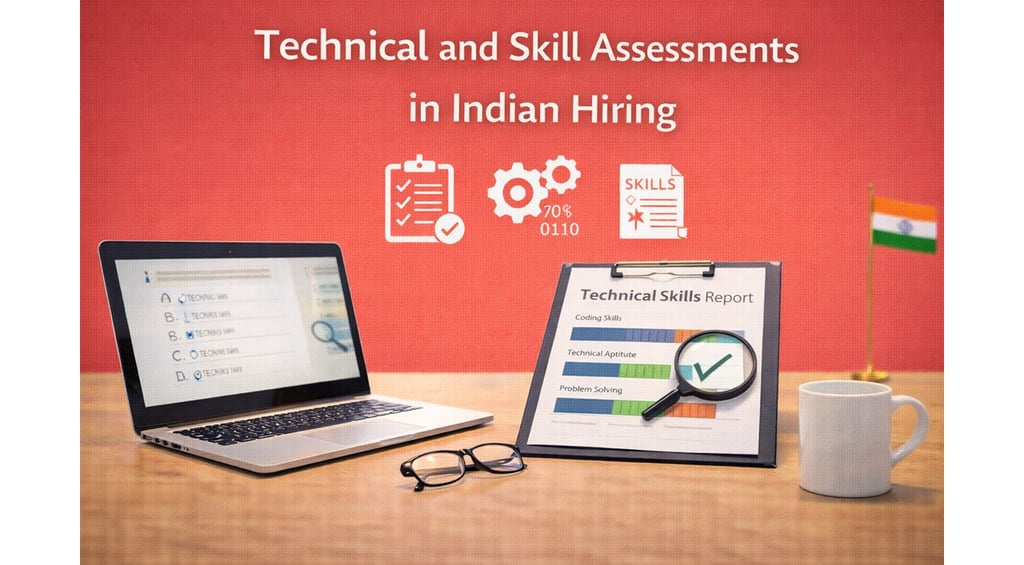
Technical and skill assessments are critical in determining whether a candidate can actually perform the job they are being hired for. In Indian organisations, hiring decisions often rely heavily on resumes and interviews, which may not always reflect real capability. Poorly designed assessments can either reject capable candidates or allow underqualified hires to slip through.
A structured and role-relevant assessment approach helps HR and hiring managers evaluate practical competence while maintaining fairness, consistency, and efficiency.
Indian Hiring Context for Skill Assessments
Skill assessment practices in India are shaped by several factors:
Wide variation in education quality across institutes
Resume exaggeration of skills and project experience
High competition for technical talent
Time constraints in fast-paced hiring environments
Diverse roles, from shop-floor to highly specialised tech positions
These realities make practical skill validation essential.
Core Principles of Technical and Skill Assessments
1. Align Assessments to Job Requirements
Assessments must reflect actual job demands:
Identify core technical skills required on day one
Distinguish between must-have and trainable skills
Avoid generic tests that do not match the role
Relevance improves candidate experience and decision accuracy.
2. Choose the Right Assessment Method
Different roles require different assessment approaches:
Written or online tests for theoretical understanding
Practical tasks or simulations for hands-on roles
Case studies for problem-solving and judgement
Demonstrations or sample work for creative or technical roles
HR should ensure assessment methods are appropriate and proportionate.
3. Ensure Fairness and Consistency
Assessment discipline is critical:
Use the same test or task for comparable roles
Apply uniform evaluation criteria
Avoid last-minute changes during hiring drives
Provide clear instructions and time limits
Consistency protects HR credibility and reduces disputes.
4. Balance Rigor with Practicality
Overly complex assessments can backfire:
Avoid excessive testing that delays hiring
Consider candidate effort and time investment
Use assessments as decision aids, not elimination tools alone
Practical balance ensures assessments add value without slowing recruitment.
5. Integrate Assessment Outcomes into Decisions
Assessment results must be used meaningfully:
Combine scores with interview and behavioural inputs
Discuss assessment outcomes with hiring managers
Document rationale where assessment results are overridden
This ensures assessments inform decisions rather than becoming formalities.
HR’s Practical Perspective
HR acts as the gatekeeper of assessment quality:
Define assessment standards and approval processes
Partner with business teams to design relevant tests
Monitor assessment effectiveness and outcomes
Ensure compliance and documentation
Review assessment tools periodically
Effective HR oversight ensures skill assessments support hiring quality and fairness.
Conclusion
Technical and skill assessments are essential for validating real capability in Indian hiring environments. When aligned to job needs, applied consistently, and integrated into decision-making, they reduce hiring risk and improve workforce performance.
HR’s role is to ensure assessments are practical, fair, and used responsibly as part of a holistic selection process.
🗹 Technical and Skill Assessment Checklist
🗹 Identify role-critical technical skills upfront
🗹 Select assessment methods aligned to job requirements
🗹 Use consistent tests and evaluation criteria
🗹 Provide clear instructions and timelines to candidates
🗹 Balance assessment depth with hiring timelines
🗹 Combine assessment outcomes with interview feedback
🗹 Document assessment results and decisions
🗹 Review assessment effectiveness periodically
🗹 Ensure fairness and candidate respect throughout
Technical and Skill Assessment Framework
Conclusion--
Effective labour law compliance depends on how well HR operations, payroll, and business processes work together. When compliance is embedded into everyday workflows, organisations reduce risk, improve accuracy, and build sustainable governance systems. HR teams that prioritise integration over isolation are better positioned to manage compliance confidently and consistently.
HireDesk India © 2026 | All Rights Reserved
"Thoughtful guidance for everyday HR"


Quick Links
Topics
Connect
_______________________________________________________________________________________________________________________________________________________________________________________
HireDesk is a free HR knowledge platform focused on practical, India-specific workplace guidance. We help HR professionals, managers, and learners navigate people practices with clarity, responsibility, and real-world relevance.