
Termination, Discharge and Dismissal in Factories: HR Legal Framework
INDUSTRIAL RELATIONS & FACTORY HR
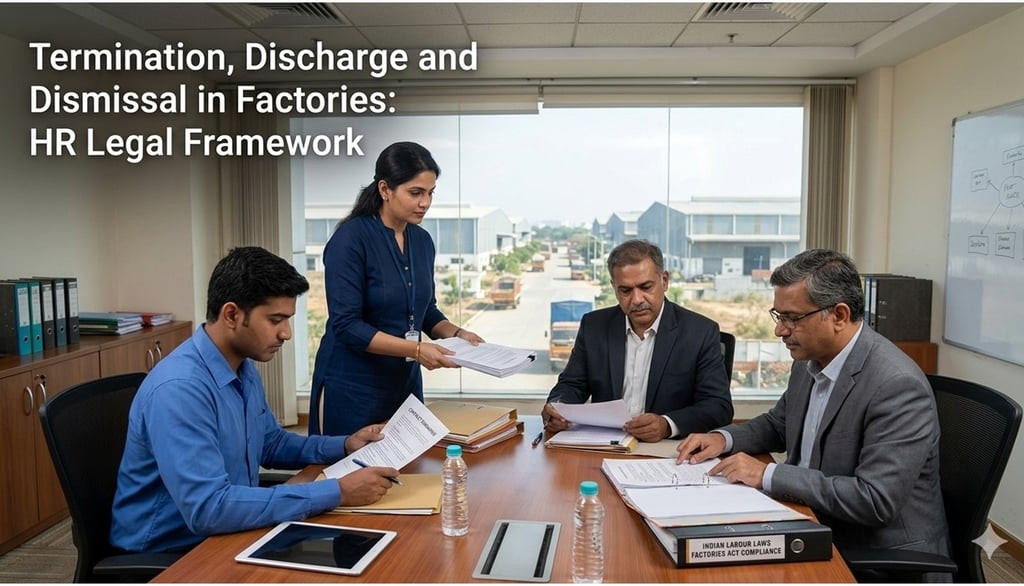

Ending employment in a factory setting is one of the most sensitive and legally scrutinised HR actions. In Indian industrial relations, termination-related decisions are often challenged not only on facts, but on process, intent, and fairness.
Factory HR teams must clearly understand the difference between termination, discharge, and dismissal, and apply each strictly within the framework of Standing Orders, labour laws, and principles of natural justice. Misclassification or procedural shortcuts can result in reinstatement orders, back wages, and industrial unrest.
Understanding the Three Concepts Clearly
Though commonly used interchangeably, these terms have distinct legal and practical meanings.
Termination: Separation not linked to misconduct
Discharge: Separation due to incapacity or non-disciplinary reasons
Dismissal: Punitive separation following proved misconduct
HR must choose the correct route based on facts—not convenience.
Termination of Employment: HR Perspective
Termination generally refers to ending employment without stigma or punishment.
Common Termination Scenarios
Retrenchment due to redundancy
Closure of department or unit
Expiry of fixed-term employment
Non-renewal of contract
Termination must follow statutory notice, compensation, and procedural safeguards.
Discharge from Service
Discharge refers to separation due to inability to continue employment, not misconduct.
Common Grounds
Medical unfitness
Continuous poor performance despite support
Loss of required qualification or licence
Role becoming unsuitable due to operational changes
Discharge must be humane, well-documented, and free from punitive intent.
Dismissal for Misconduct
Dismissal is the most severe punishment under Standing Orders.
When Dismissal Is Justified
Proven serious misconduct
Enquiry conducted fairly
Findings clearly establish guilt
Punishment is proportionate
Dismissal without enquiry is rarely sustainable.
Legal Framework Governing Separation
HR decisions must align with multiple laws.
Key Legal Touchpoints
Industrial Disputes Act / Industrial Relations Code
Certified Standing Orders
Principles of natural justice
Judicial precedents on proportionality
Compliance is assessed holistically, not in isolation.
HR’s Role in Choosing the Correct Route
HR must guide management away from impulsive decisions.
HR should:
Analyse intent, impact, and evidence
Match action with Standing Orders definitions
Ensure procedural compliance
Assess legal and IR implications
Document rationale thoroughly
Wrong classification weakens the employer’s defence.
Common Errors in Factory Separations
Using termination to avoid enquiry
Discharging employees for misconduct
Ignoring retrenchment compensation
Poor documentation
Inconsistent penalties
These mistakes often escalate disputes unnecessarily.
Best Practices for Factory HR
Treat separation as a process, not an event
Maintain dignity and fairness
Communicate clearly with employee and union
Seek legal review in complex cases
Align separation with industrial relations strategy
Professional handling reduces resistance and litigation.
Conclusion
Termination, discharge, and dismissal are not interchangeable HR tools. Each carries distinct legal meaning, consequences, and procedural requirements. For factory HR teams, success lies in correct classification, disciplined process, and proportional action.
Handled correctly, separation decisions uphold organisational discipline while preserving legal defensibility and industrial harmony.
🗹 HR Checklist: Separation Decisions in Factories
🗹 Identify correct separation category
🗹 Refer to Standing Orders before action
🗹 Follow statutory notice and compensation rules
🗹 Conduct domestic enquiry for misconduct cases
🗹 Ensure proportionality of punishment
🗹 Document decision rationale thoroughly
🗹 Communicate separation respectfully
🗹 Review legal and IR risks before final order
Termination vs Discharge vs Dismissal – HR Reference Table
Conclusion--
Effective labour law compliance depends on how well HR operations, payroll, and business processes work together. When compliance is embedded into everyday workflows, organisations reduce risk, improve accuracy, and build sustainable governance systems. HR teams that prioritise integration over isolation are better positioned to manage compliance confidently and consistently.
HireDesk India © 2026 | All Rights Reserved
"Thoughtful guidance for everyday HR"


Quick Links
Topics
Connect
_______________________________________________________________________________________________________________________________________________________________________________________
HireDesk is a free HR knowledge platform focused on practical, India-specific workplace guidance. We help HR professionals, managers, and learners navigate people practices with clarity, responsibility, and real-world relevance.