
The Role of HR in Scaling an SME from 10 to 500 Employees
SME HR OPERATIONS
Introduction
Scaling from a 10-employee setup to a 500-employee organisation is not just a business journey — it is a people transformation. In Indian SMEs, growth often happens in phases, driven by opportunity rather than long-term workforce planning. Without strong HR involvement, rapid scaling can result in chaos, compliance risk, and cultural dilution.
This article explains how HR must evolve at different growth stages and act as a stability anchor as the organisation scales.
Why HR Becomes Critical During Growth
In early-stage SMEs, founders manage people informally. As headcount increases, this approach breaks down.
Growth introduces:
Increased hiring volume
Complex compliance obligations
Multiple management layers
Cultural fragmentation
Higher employee expectations
HR’s role shifts from administration to governance, consistency, and capability building.
HR Priorities at Different Growth Stages
HR priorities change as the organisation scales.
10–30 employees: basic structure and documentation
30–100 employees: process standardisation and compliance
100–300 employees: performance systems and leadership development
300–500 employees: governance, scalability, and culture reinforcement
Anticipating these shifts prevents reactive firefighting.
Building Scalable HR Systems Without Over-Engineering
SMEs often either delay systems too long or implement heavy enterprise solutions too early.
HR should focus on:
Processes that scale with headcount
Simple, repeatable workflows
Role clarity and accountability
Gradual technology adoption
Scalability matters more than sophistication.
HR as a Partner to Founders and Leadership
During scaling, founders need HR as a thinking partner, not just an executor.
HR should:
Flag people risks early
Support leadership transitions
Balance speed with discipline
Protect organisational culture
Bring data-backed people insights
Trust between HR and founders is essential.
Managing Culture During Rapid Expansion
Culture weakens fastest during growth.
HR must consciously reinforce:
Core values and expected behaviours
Fairness and consistency in decisions
Manager capability and people leadership
Employee communication and transparency
Culture cannot be left to chance.
Preparing HR Teams for the Scale Journey
HR itself must evolve.
This includes:
Strengthening HR capability
Dividing roles (recruitment, operations, compliance)
Upskilling managers in people leadership
Leveraging external advisors where required
HR must grow ahead of the organisation, not behind it.
Checklist: HR’s Role in SME Scaling
🗹 Anticipate people challenges at each growth stage
🗹 Introduce structure before chaos sets in
🗹 Balance speed with compliance and discipline
🗹 Build scalable HR processes and systems
🗹 Strengthen managers’ people leadership capability
🗹 Use HR data to support leadership decisions
🗹 Protect and reinforce organisational culture
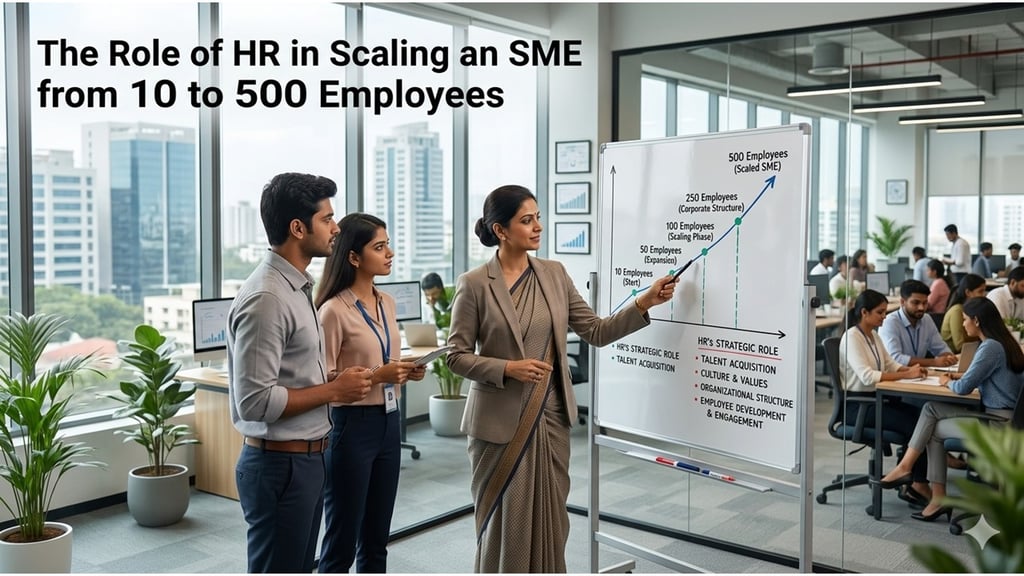
HR Focus Areas Across SME Growth Stages
Conclusion
Scaling an SME from 10 to 500 employees requires HR to move from support function to organisational backbone. When HR anticipates growth needs, introduces structure at the right time, and partners closely with leadership, scaling becomes sustainable rather than stressful.
HireDesk India © 2026 | All Rights Reserved
"Thoughtful guidance for everyday HR"


Quick Links
Topics
Connect
_______________________________________________________________________________________________________________________________________________________________________________________
HireDesk is a free HR knowledge platform focused on practical, India-specific workplace guidance. We help HR professionals, managers, and learners navigate people practices with clarity, responsibility, and real-world relevance.