
Understanding PF and ESIC Applicability in Simple Terms
PAYROLL, PF & BENEFITS
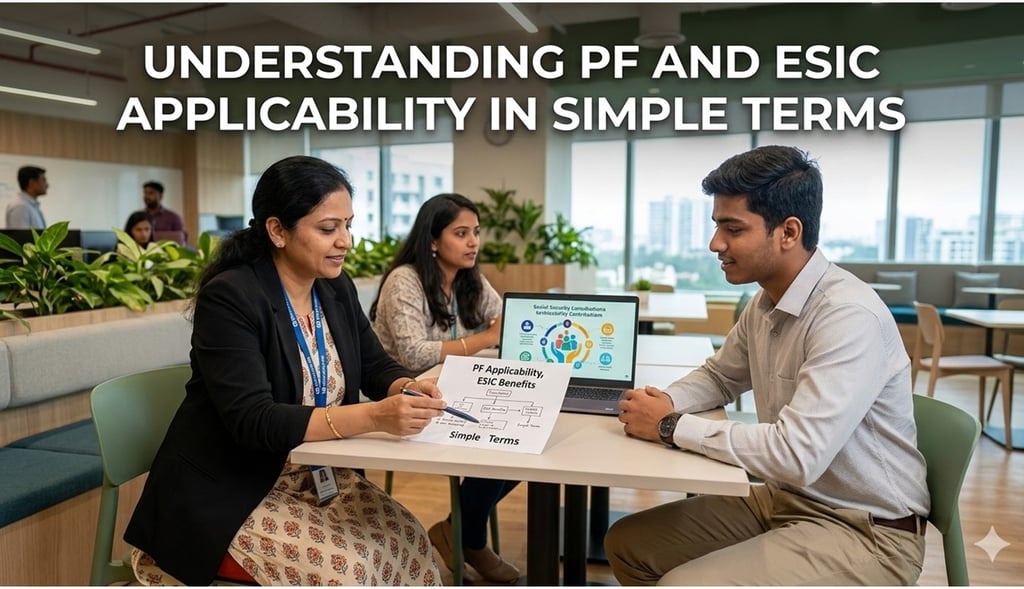
Provident Fund (PF) and Employees’ State Insurance (ESIC) are two of the most critical statutory benefits in Indian payroll administration. While the concepts are well established, confusion often arises around eligibility, wage limits, coverage thresholds, and ongoing compliance responsibilities.
This article explains PF and ESIC applicability in clear, practical terms, helping HR professionals understand when these laws apply, who must be covered, and what HR is responsible for each month.
Why PF and ESIC Clarity Matters for HR
PF and ESIC compliance is closely tied to payroll accuracy. Errors in applicability or deductions can result in:
Employee dissatisfaction
Statutory notices and penalties
Retrospective corrections and audits
For HR, clarity ensures consistent application and confident communication with employees.
Provident Fund (PF): Applicability Explained
The Employees’ Provident Fund applies to most organised establishments in India.
PF becomes applicable when:
The organisation employs 20 or more employees
Employees earn basic wages up to ₹15,000 per month (mandatory coverage)
Once covered, PF applicability generally continues even if employee count falls below the threshold.
Key PF points HR must remember
Employee contribution: 12% of basic wages
Employer contribution: 12% (split between EPF and EPS)
Employees earning above ₹15,000 may be covered by mutual consent
PF applies from the date of joining, not confirmation
Employees’ State Insurance (ESIC): Applicability Explained
ESIC is a social security scheme providing medical and cash benefits.
ESIC becomes applicable when:
The organisation employs 10 or more employees (threshold may vary by state)
Employees earn gross wages up to ₹21,000 per month
Coverage is mandatory for eligible employees from the date of joining.
Key ESIC points HR must remember
Employee contribution: 0.75% of gross wages
Employer contribution: 3.25% of gross wages
Contributions continue during contribution periods even if wages exceed the limit temporarily
Common Applicability Scenarios HR Encounters
HR teams often face questions such as:
Should interns or trainees be covered?
Does PF apply to consultants or contract staff?
What happens when wages cross eligibility limits?
The answers depend on employment relationship, wage structure, and statutory definitions—not titles alone.
PF and ESIC Compliance Checklist for HR
Use this checklist to ensure ongoing compliance:
Applicability and Coverage
☐ Employee count threshold assessed
☐ Eligible employees identified correctly
☐ Coverage started from joining date
Payroll and Deductions
☐ Correct wage components considered
☐ Contributions calculated accurately
☐ Changes in wages reviewed monthly
Filing and Records
☐ Monthly contributions remitted on time
☐ Returns and challans filed correctly
☐ Employee records maintained and updated
Common PF and ESIC Compliance Mistakes
HR teams should avoid:
Delaying coverage until confirmation
Misclassifying employees to avoid coverage
Ignoring applicability after threshold is crossed
Treating PF/ESIC as payroll-only responsibilities
Statutory compliance remains an HR accountability even when payroll is outsourced.
Conclusion
Conclusion
Understanding PF and ESIC applicability is essential for responsible payroll management. When HR teams apply coverage rules consistently and maintain accurate records, compliance becomes predictable rather than reactive.
Related Articles
HireDesk India © 2026 | All Rights Reserved
"Thoughtful guidance for everyday HR"


Quick Links
Topics
Connect
_______________________________________________________________________________________________________________________________________________________________________________________
HireDesk is a free HR knowledge platform focused on practical, India-specific workplace guidance. We help HR professionals, managers, and learners navigate people practices with clarity, responsibility, and real-world relevance.