
Using Data and Analytics in Recruitment Decision-Making
RECRUITMENT AND HIRING
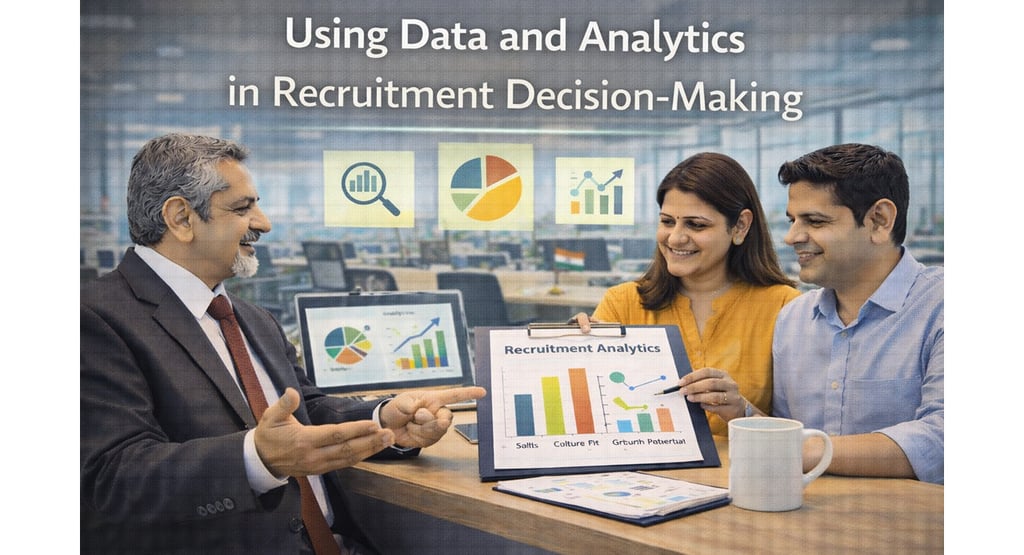
Recruitment data and analytics help HR take informed decisions across sourcing, screening, selection, and offer management. In Indian organisations, where hiring conditions vary widely by role, location, and skill availability, data brings structure and discipline to what is often a high-pressure process.
The purpose of recruitment analytics is not automation for its own sake, but better judgement, consistency, and risk control.
What Recruitment Analytics Means in Practice
Recruitment analytics refers to the use of hiring data to:
Identify patterns and bottlenecks
Compare sourcing and selection effectiveness
Improve predictability and planning
Reduce bias and inconsistency
Analytics should support human decision-making, not replace it.
Key Data Sources in Recruitment
1. Demand and Planning Data
Approved manpower plans
Hiring forecasts and timelines
Replacement vs growth hiring data
This data helps HR assess planning accuracy and anticipate pressure points.
2. Sourcing and Funnel Data
Source-wise applications and conversions
Shortlisting and interview ratios
Offer and joining outcomes
Funnel data highlights which channels and stages deliver quality hires.
3. Cost and Resource Data
Recruitment spend by source
Agency fees and referral payouts
Recruiter workload and productivity
Cost data supports informed trade-offs between speed and expense.
4. Quality and Outcome Data
Early attrition and probation failures
Hiring manager feedback
Performance indicators of new hires (where feasible)
Outcome data validates whether hiring decisions are delivering value.
5. Risk and Compliance Data
Background verification status
Documentation completion
Deviations and approval exceptions
This data ensures governance and legal safety.
Applying Analytics to Recruitment Decisions
Improving Sourcing Decisions
Analytics can show:
Which sources deliver joiners, not just resumes
Cost vs quality trade-offs
Location or role-specific channel effectiveness
This prevents over-reliance on anecdotal preferences.
Strengthening Screening and Selection
Data can help HR:
Validate screening criteria effectiveness
Identify bias or inconsistency across interviewers
Improve interview-to-offer ratios
Structured analysis improves selection discipline.
Managing Offers and Joining Risk
Analytics can identify:
Patterns in offer rejections or dropouts
Compensation misalignment by role or location
Timeline-related joining failures
This enables proactive risk mitigation.
Responsible Use of Recruitment Analytics
Data Quality First
Analytics is only as reliable as the data captured. HR must ensure:
Standard definitions and fields
Consistent data entry discipline
Periodic data validation
Poor data leads to misleading insights.
Ethics and Privacy
Indian HR teams must:
Use candidate data only for legitimate purposes
Avoid intrusive or irrelevant data collection
Ensure confidentiality and access controls
Ethical usage protects both candidates and the organisation.
Avoid Over-Automation
Blind reliance on algorithms or scores can:
Reinforce existing bias
Ignore contextual judgement
Exclude unconventional but capable candidates
Analytics should inform decisions, not dictate them.
HR’s Role in Analytics Adoption
HR is responsible for:
Defining what data matters
Educating stakeholders on interpretation
Translating insights into process improvements
Ensuring ethical and compliant use
The focus should remain on better hiring outcomes, not dashboards.
Conclusion
Using data and analytics in recruitment improves consistency, predictability, and decision quality—when applied responsibly. Indian HR teams should focus on practical, high-impact insights, supported by strong data discipline and ethical safeguards. Analytics should enhance human judgement, not replace it.
🗹 Recruitment Analytics Checklist
🗹 Identify decision points where data adds real value
🗹 Capture accurate and consistent recruitment data
🗹 Analyse sourcing, funnel, cost, and outcome data together
🗹 Use analytics to reduce bias and inconsistency
🗹 Interpret insights with business and location context
🗹 Protect candidate data privacy and confidentiality
🗹 Avoid over-reliance on automated scores
🗹 Convert insights into process improvements
Recruitment Analytics: Data Types and Decision Use
Conclusion--
Effective labour law compliance depends on how well HR operations, payroll, and business processes work together. When compliance is embedded into everyday workflows, organisations reduce risk, improve accuracy, and build sustainable governance systems. HR teams that prioritise integration over isolation are better positioned to manage compliance confidently and consistently.
HireDesk India © 2026 | All Rights Reserved
"Thoughtful guidance for everyday HR"


Quick Links
Topics
Connect
_______________________________________________________________________________________________________________________________________________________________________________________
HireDesk is a free HR knowledge platform focused on practical, India-specific workplace guidance. We help HR professionals, managers, and learners navigate people practices with clarity, responsibility, and real-world relevance.