
Voluntary Retirement Schemes (VRS) in Factories: Legal Framework and HR Execution
INDUSTRIAL RELATIONS & FACTORY HR
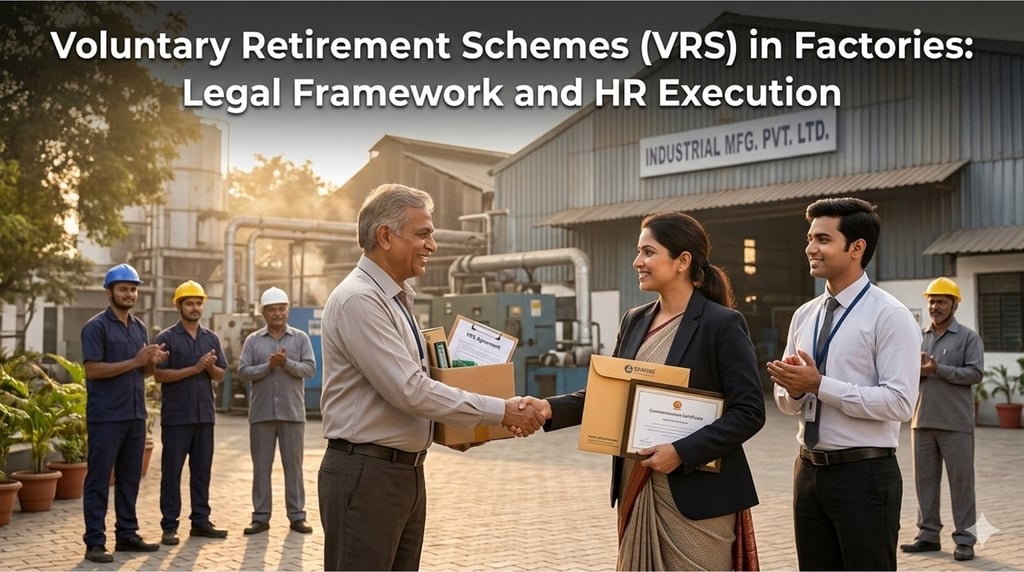
Voluntary Retirement Schemes (VRS) are commonly used by Indian factories to manage surplus manpower, restructure operations, or improve long-term cost efficiency. While VRS is positioned as a voluntary exit option, poor design or execution can quickly lead to disputes, allegations of coercion, or regulatory scrutiny.
For Factory HR teams, VRS is not merely a financial exercise. It requires legal clarity, transparent communication, accurate calculation, and disciplined execution to ensure acceptance is truly voluntary and legally sustainable.
This article explains how HR must design, implement, and manage VRS in Indian factories from a practical and compliant perspective.
Legal Framework Governing VRS
VRS in factories is governed by:
Industrial Disputes Act, 1947
Industrial Relations Code, 2020
Judicial principles evolved through court judgments
Applicable Standing Orders and service rules
While there is no single statute exclusively governing VRS, courts closely examine fairness, voluntariness, and procedural integrity.
When Factories Opt for VRS
Factories typically introduce VRS in situations such as:
Persistent surplus manpower
Technological upgradation or automation
Business restructuring or cost rationalisation
Declining demand or capacity utilisation
Long-term industrial relations stability planning
HR must ensure that VRS is not used as a shortcut to avoid retrenchment procedures.
Designing a Fair and Defensible VRS
A well-designed VRS should clearly specify:
Eligibility criteria
Benefits and compensation formula
Method of application and acceptance
Payment timelines
Finality and waiver clauses
HR must ensure the scheme is simple, transparent, and uniformly applied.
HR’s Role in VRS Communication
Communication is the most sensitive aspect of VRS. HR must:
Explain the scheme clearly without pressure
Avoid individual targeting or coercion
Provide sufficient time for decision-making
Address employee queries objectively
Maintain written records of communication
Any perception of force or threat can invalidate the scheme.
Acceptance, Settlement and Exit Formalities
Once applications are received, HR must:
Scrutinise eligibility carefully
Issue formal acceptance letters
Process payments within committed timelines
Complete statutory and service settlement
Close access, ID, and records systematically
Delayed payments are a major cause of post-VRS disputes.
Common HR Risks in VRS Implementation
Frequent pitfalls include:
Informal pressure on senior or high-cost employees
Ambiguous eligibility conditions
Inconsistent benefit calculations
Poor documentation
Delay in disbursement
These risks can convert a voluntary scheme into a contested exit.
Conclusion
VRS can be an effective workforce management tool when implemented with discipline, transparency, and legal awareness. HR’s role is central—from design to communication to closure.
Factories that handle VRS professionally protect themselves from disputes while preserving organisational credibility and industrial harmony.
🗹 Factory HR Checklist: VRS Implementation
🗹 Assess genuine business need for VRS
🗹 Design clear eligibility and benefit structure
🗹 Align scheme with Standing Orders
🗹 Communicate without pressure or coercion
🗹 Allow reasonable decision time
🗹 Issue formal acceptance letters
🗹 Ensure timely and accurate payments
🗹 Maintain complete documentation
Voluntary Retirement Scheme – HR Reference Table
Conclusion--
Effective labour law compliance depends on how well HR operations, payroll, and business processes work together. When compliance is embedded into everyday workflows, organisations reduce risk, improve accuracy, and build sustainable governance systems. HR teams that prioritise integration over isolation are better positioned to manage compliance confidently and consistently.
HireDesk India © 2026 | All Rights Reserved
"Thoughtful guidance for everyday HR"


Quick Links
Topics
Connect
_______________________________________________________________________________________________________________________________________________________________________________________
HireDesk is a free HR knowledge platform focused on practical, India-specific workplace guidance. We help HR professionals, managers, and learners navigate people practices with clarity, responsibility, and real-world relevance.