
Workforce Planning and Manpower Management: A Practical HR Approach
WORKFORCE PLANNING & MANPOWER
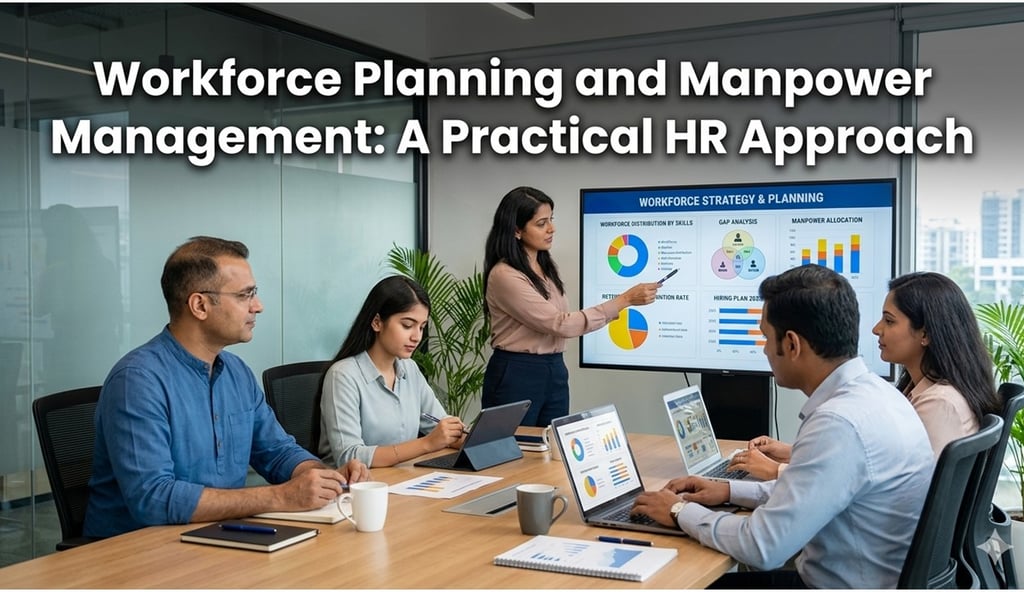
Workforce planning is often misunderstood as a headcount exercise or an annual budgeting activity. In reality, it is a continuous HR process that ensures the organisation has the right number of people, with the right skills, at the right time—without overstaffing or operational strain.
This pillar article explains workforce planning and manpower management from a practical HR perspective, especially in the context of Indian organisations.
What Is Workforce Planning?
Workforce planning is the process of:
Assessing current workforce capacity and skills
Anticipating future business and operational needs
Identifying gaps and risks
Taking planned actions to address them
It connects business direction with people decisions.
Workforce Planning vs Manpower Management
While closely linked, they serve different purposes:
Workforce planning focuses on future needs and strategic alignment
Manpower management focuses on day-to-day deployment, utilisation, and control
HR must balance both to avoid short-term firefighting and long-term misalignment.
HR’s Role in Workforce Planning
HR contributes by:
Analysing workforce data and trends
Partnering with business leaders on demand forecasting
Translating plans into hiring, redeployment, or reskilling actions
Monitoring manpower utilisation and attrition
HR acts as the integrator between strategy and execution.
Indian Workplace Realities
In Indian organisations, workforce planning is influenced by:
Rapid business changes and scaling needs
Skill availability and hiring timelines
Attrition volatility
Contract and contingent workforce usage
Plans must remain flexible and reviewable.
Common Workforce Planning Challenges
Reactive hiring driven by short-term pressure
Lack of reliable workforce data
Poor coordination between HR and business teams
Treating manpower plans as static documents
These issues reduce planning effectiveness.
Workforce Planning Orientation Checklist for HR
☐ Understand business goals and timelines
☐ Map current workforce capacity and skills
☐ Identify critical roles and risk areas
☐ Review manpower plans periodically
☐ Align hiring, reskilling, and deployment actions
Conclusion
Effective workforce planning enables HR to move from reactive hiring to proactive people management. When HR balances planning with operational realities, manpower decisions become more predictable and sustainable.
Conclusion--
Effective labour law compliance depends on how well HR operations, payroll, and business processes work together. When compliance is embedded into everyday workflows, organisations reduce risk, improve accuracy, and build sustainable governance systems. HR teams that prioritise integration over isolation are better positioned to manage compliance confidently and consistently.
Related Articles
HireDesk India © 2026 | All Rights Reserved
"Thoughtful guidance for everyday HR"


Quick Links
Topics
Connect
_______________________________________________________________________________________________________________________________________________________________________________________
HireDesk is a free HR knowledge platform focused on practical, India-specific workplace guidance. We help HR professionals, managers, and learners navigate people practices with clarity, responsibility, and real-world relevance.