
Workplace Accidents and Reporting Obligations for HR
COMPLIANCE & LABOUR LAWS
Introduction--
Once a candidate accepts an offer, the period between acceptance and joining becomes a critical phase in the recruitment lifecycle. This pre-joining window influences whether a candidate actually joins, how prepared they feel on Day One, and how quickly they settle into the organisation. For HR, effective pre-joining engagement and onboarding planning are essential to convert offers into confident, committed employees.
This article outlines practical approaches HR teams can adopt to manage pre-joining engagement and establish strong onboarding foundations—without overcomplicating the process.
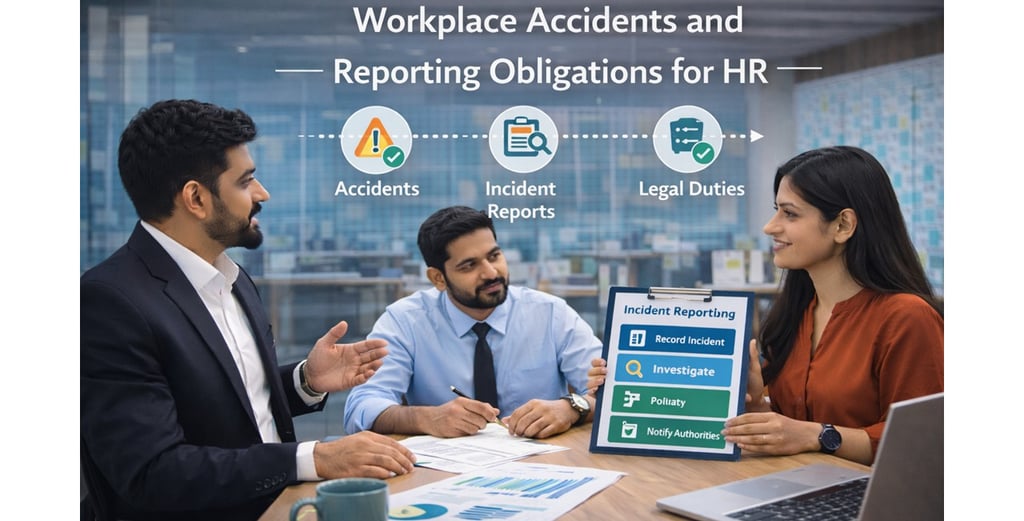
Workplace accidents are one of the most sensitive compliance areas for HR and Admin teams in India. Beyond employee welfare, accidents trigger strict legal reporting duties, scrutiny by labour authorities, and potential criminal liability for employers.
In many organisations, accidents are handled informally at first — medical aid is arranged, the situation is “managed”, and reporting is delayed or missed. This is precisely where serious compliance exposure begins.
This article explains what legally qualifies as a reportable accident, who must report, to whom, and how HR should manage the process without panic or concealment.
1. Legal Framework Governing Accident Reporting
Accident reporting obligations arise mainly under:
Factories Act, 1948
State Factories Rules
Employees’ State Insurance Act (ESIC)
Occupational Safety, Health & Working Conditions (OSH) Code (future-facing)
Different laws apply depending on:
Type of establishment (factory vs non-factory)
Coverage under ESIC
Severity and outcome of the accident
HR must first identify which law applies before taking action.
2. What Is a Reportable Workplace Accident?
Under Indian labour laws, not every injury requires statutory reporting. However, the following must be reported:
Death resulting from a workplace accident
Injury causing permanent disablement
Injury preventing the employee from working for 48 hours or more
Accidents involving dangerous occurrences (explosions, fire, machinery failure, toxic leaks)
Any accident notified as reportable under state rules
Minor first-aid cases generally do not trigger reporting, but records must still be maintained.
3. Who Is Responsible for Reporting?
Legally, the responsibility lies with:
Occupier and Manager (Factories Act)
Employer / Principal Employer (other establishments)
In practice, HR and Admin teams execute the process, including:
Drafting and submitting statutory notices
Coordinating with safety officers and plant heads
Maintaining accident registers and records
Delegation does not dilute employer liability.
4. Reporting Timelines and Authorities
Typical statutory timelines include:
Immediate intimation (within 12–24 hours) for fatal or serious accidents
Written notice to:
Factory Inspector / Labour Department
ESIC authorities (where applicable)
Local police (in case of death or serious injury)
Delays or omissions are treated as separate offences, even if the accident itself was unavoidable.
5. HR’s Role During and After an Accident
HR’s role is both procedural and judgement-based:
Ensure injured employee receives prompt medical care
Secure the accident site for investigation
Avoid altering or disturbing evidence
Coordinate statutory reporting accurately and on time
Support internal investigation and corrective action
Handle communication with employees, unions, and authorities
HR should never suppress reporting to “avoid trouble” — this often escalates liability.
6. Common Compliance Failures Seen in Inspections
Inspectors frequently flag:
Failure to report accidents within timelines
Incomplete or incorrect accident notices
No accident register or outdated entries
Mismatch between ESIC records and internal data
No follow-up preventive measures
Such gaps suggest systemic negligence, not isolated oversight.
Conclusion
Workplace accidents are stressful events, but they require calm, structured compliance response, not concealment or delay. Indian labour laws treat accident reporting as a serious statutory duty, independent of fault or intent.
For HR teams, preparedness — clear protocols, role clarity, and documentation discipline — is the only reliable defence when accidents occur.
🗹 HR Compliance Checklist: Accident Reporting Obligations
🗹 Identify applicable law based on establishment and coverage
🗹 Classify accident severity immediately
🗹 Provide medical aid without delay
🗹 Notify statutory authorities within prescribed timelines
🗹 Submit written accident reports accurately
🗹 Maintain accident registers and supporting records
🗹 Coordinate with ESIC for insured employees
🗹 Preserve evidence for inspection or inquiry
🗹 Review root cause and corrective actions
🗹 Train supervisors on accident escalation protocols
Workplace Accidents and Reporting Requirements
HireDesk India © 2026 | All Rights Reserved
"Thoughtful guidance for everyday HR"


Quick Links
Topics
Connect
_______________________________________________________________________________________________________________________________________________________________________________________
HireDesk is a free HR knowledge platform focused on practical, India-specific workplace guidance. We help HR professionals, managers, and learners navigate people practices with clarity, responsibility, and real-world relevance.