
Workplace Culture in Indian Organisations: What HR Can Influence and What It Cannot
EMPLOYEE EXPERIENCE & CULTURE
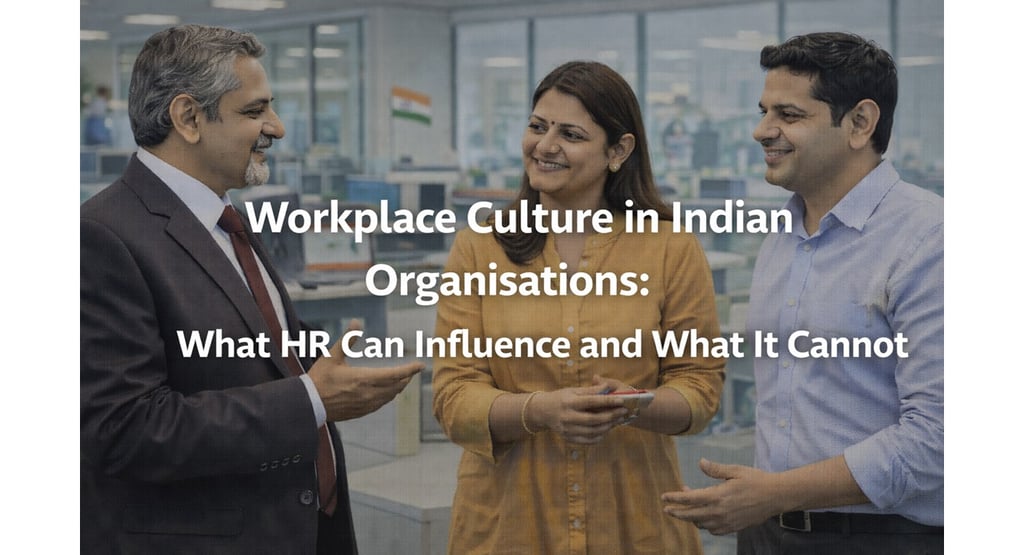
Workplace culture is often spoken about as something HR must “build” or “fix”. In reality, culture in Indian organisations is shaped by many forces — leadership behaviour, business pressures, social norms, and long-standing habits. HR plays an important role, but not an all-powerful one.
When HR tries to take ownership of everything cultural, expectations become unrealistic and credibility suffers. This article clarifies what HR can realistically influence in Indian workplaces, what lies outside HR’s direct control, and how HR should focus its effort where it truly matters.
Understanding How Culture Forms in Indian Organisations
Culture is not created in workshops or value posters. It develops over time based on:
How leaders behave under pressure
How managers treat people day to day
Which behaviours are rewarded or ignored
How mistakes, conflicts, and failures are handled
In Indian organisations, additional factors play a strong role:
Hierarchical structures and respect for authority
Founder or promoter influence
Informal power networks and relationships
Social and regional diversity
HR operates within these realities, not outside them.
What HR Can Directly Influence
There are clear areas where HR’s influence is strong and legitimate.
1. People Processes and Consistency
HR controls the design and governance of processes such as recruitment, onboarding, performance management, grievance handling, and exits. When these are applied consistently, culture becomes more predictable and fair.
2. Behavioural Standards
HR can define minimum standards around:
Respectful behaviour
Workplace conduct
Non-discrimination and dignity
Professional communication
While HR cannot control attitudes, it can enforce boundaries.
3. Manager Enablement and Guardrails
HR influences culture by shaping how managers operate — through training, guidelines, escalation frameworks, and consequences for repeated behavioural issues.
What HR Can Influence Indirectly
Some aspects of culture are shaped through influence rather than control.
Leadership role modelling (through feedback and data)
Openness in communication (by creating safe channels)
Fairness perception (through transparency and documentation)
Learning mindset (by encouraging development over blame)
Here, HR’s role is advisory and facilitative, not directive.
What HR Cannot Control (and Should Not Pretend To)
Certain cultural elements sit outside HR’s direct control:
Individual personality traits and personal values
Deep-rooted leadership styles of promoters or founders
Business decisions driven by market or financial pressure
Informal social relationships among employees
Attempting to “fix” these directly often leads to resistance or token initiatives.
Common Mistakes HR Makes Around Culture
Some frequent pitfalls include:
Taking responsibility for leadership behaviour without authority
Launching culture initiatives without operational backing
Ignoring informal practices that contradict formal values
Avoiding tough conversations to maintain harmony
Effective HR teams choose focus over ambition.
HR’s Practical Balancing Act
HR’s real value lies in balance:
Being firm on non-negotiables
Flexible where business realities demand it
Vocal when culture is being compromised
Pragmatic about influence limits
Culture improves when HR applies judgement consistently, not when it promises transformation everywhere.
Conclusion
Workplace culture in Indian organisations is complex and layered. HR cannot control every element — and should not be expected to. However, by owning process discipline, behavioural standards, and managerial guardrails, HR can significantly influence how culture is experienced on the ground.
Clarity about influence versus control helps HR focus its energy, protect credibility, and contribute meaningfully to a healthier workplace culture.
HR Checklist: Focusing Cultural Effort Where It Matters
🗹 Clearly define cultural areas HR owns versus influences
🗹 Strengthen consistency in core people processes
🗹 Set and enforce minimum behavioural standards
🗹 Equip managers with practical people-management guardrails
🗹 Escalate repeated cultural risks with evidence, not emotion
🗹 Avoid symbolic initiatives without operational support
🗹 Acknowledge business and leadership constraints honestly
🗹 Focus on predictability, fairness, and dignity
🗹 Review cultural issues through risk and trust impact
Workplace Culture: HR Influence vs Reality
Conclusion--
Effective labour law compliance depends on how well HR operations, payroll, and business processes work together. When compliance is embedded into everyday workflows, organisations reduce risk, improve accuracy, and build sustainable governance systems. HR teams that prioritise integration over isolation are better positioned to manage compliance confidently and consistently.
HireDesk India © 2026 | All Rights Reserved
"Thoughtful guidance for everyday HR"


Quick Links
Topics
Connect
_______________________________________________________________________________________________________________________________________________________________________________________
HireDesk is a free HR knowledge platform focused on practical, India-specific workplace guidance. We help HR professionals, managers, and learners navigate people practices with clarity, responsibility, and real-world relevance.