
Workplace Discipline in SMEs: A Fair and Consistent HR Framework
SME HR OPERATIONS
Introduction--
Once a candidate accepts an offer, the period between acceptance and joining becomes a critical phase in the recruitment lifecycle. This pre-joining window influences whether a candidate actually joins, how prepared they feel on Day One, and how quickly they settle into the organisation. For HR, effective pre-joining engagement and onboarding planning are essential to convert offers into confident, committed employees.
This article outlines practical approaches HR teams can adopt to manage pre-joining engagement and establish strong onboarding foundations—without overcomplicating the process.
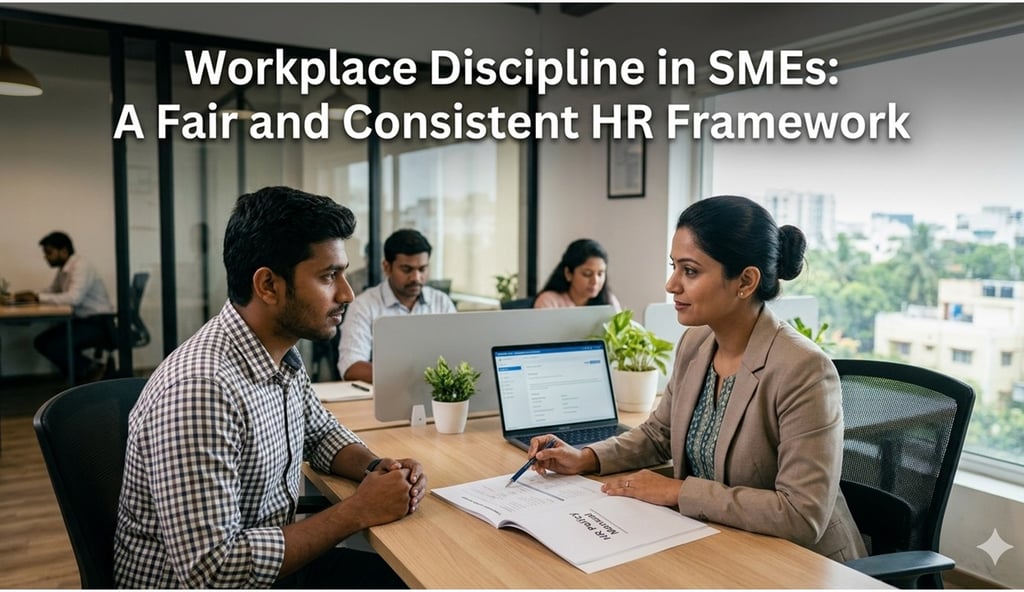
Workplace discipline is often misunderstood in Indian SMEs. It is either enforced too casually through verbal warnings or handled too harshly through sudden terminations. Both extremes create risk — legal, cultural, and operational.
For SMEs, discipline is not about punishment. It is about setting expectations, correcting behaviour, and maintaining consistency without damaging trust. This article outlines how HR can build a simple, fair, and workable discipline framework suited to small organisations.
What Workplace Discipline Means in an SME Context
In SMEs, discipline is closely linked to daily behaviour and operational reliability.
It typically covers:
Attendance and punctuality
Compliance with instructions and policies
Workplace behaviour and conduct
Respect for colleagues, customers, and assets
Discipline should be corrective first, not punitive by default.
Why SMEs Struggle With Discipline Management
Common discipline-related challenges in SMEs include:
Over-reliance on verbal warnings
Inconsistent treatment across employees
Founder or manager-driven emotional decisions
Lack of written records
Fear of “legal trouble” leading to inaction
HR’s role is to bring structure without rigidity.
Principles of a Fair Discipline Framework
A workable discipline framework for SMEs should be based on:
Clarity – employees know what is acceptable
Consistency – similar behaviour, similar action
Proportionality – punishment fits the misconduct
Documentation – basic records for every action
Opportunity to improve – unless misconduct is grave
These principles protect both the organisation and employees.
Progressive Discipline: What SMEs Can Apply
SMEs do not need complex disciplinary ladders.
A simple progressive approach usually works:
Informal counselling
Written warning
Final warning or penalty
Termination (if required)
Not all cases must start at step one — severity matters.
Role of HR, Managers, and Founders
Clear role separation avoids confusion.
Managers: identify issues, provide inputs, conduct counselling
HR: define process, issue letters, ensure fairness
Founders: intervene only in serious or high-risk cases
HR should remain the custodian of discipline processes.
Linking Discipline With Culture, Not Fear
Poorly handled discipline creates fear and silence.
Well-handled discipline:
Reinforces organisational values
Signals fairness and accountability
Improves team confidence in HR
Reduces repeat misconduct
Discipline done right strengthens culture.
Conclusion
For Indian SMEs, workplace discipline must be structured but humane. HR does not need heavy legal frameworks — only clarity, consistency, and calm judgement. A simple discipline framework protects the business while preserving trust and dignity.
Checklist: Building a Discipline Framework for SMEs
🗹 Define acceptable and unacceptable behaviours clearly
🗹 Use counselling before punishment wherever possible
🗹 Apply similar action for similar misconduct
🗹 Document all warnings and outcomes
🗹 Keep punishment proportionate to the issue
🗹 Train managers on discipline basics
🗹 Avoid emotional or impulsive decisions
🗹 Close disciplinary matters formally
Progressive Discipline Framework for SMEs
Conclusion--
Effective labour law compliance depends on how well HR operations, payroll, and business processes work together. When compliance is embedded into everyday workflows, organisations reduce risk, improve accuracy, and build sustainable governance systems. HR teams that prioritise integration over isolation are better positioned to manage compliance confidently and consistently.
HireDesk India © 2026 | All Rights Reserved
"Thoughtful guidance for everyday HR"


Quick Links
Topics
Connect
_______________________________________________________________________________________________________________________________________________________________________________________
HireDesk is a free HR knowledge platform focused on practical, India-specific workplace guidance. We help HR professionals, managers, and learners navigate people practices with clarity, responsibility, and real-world relevance.